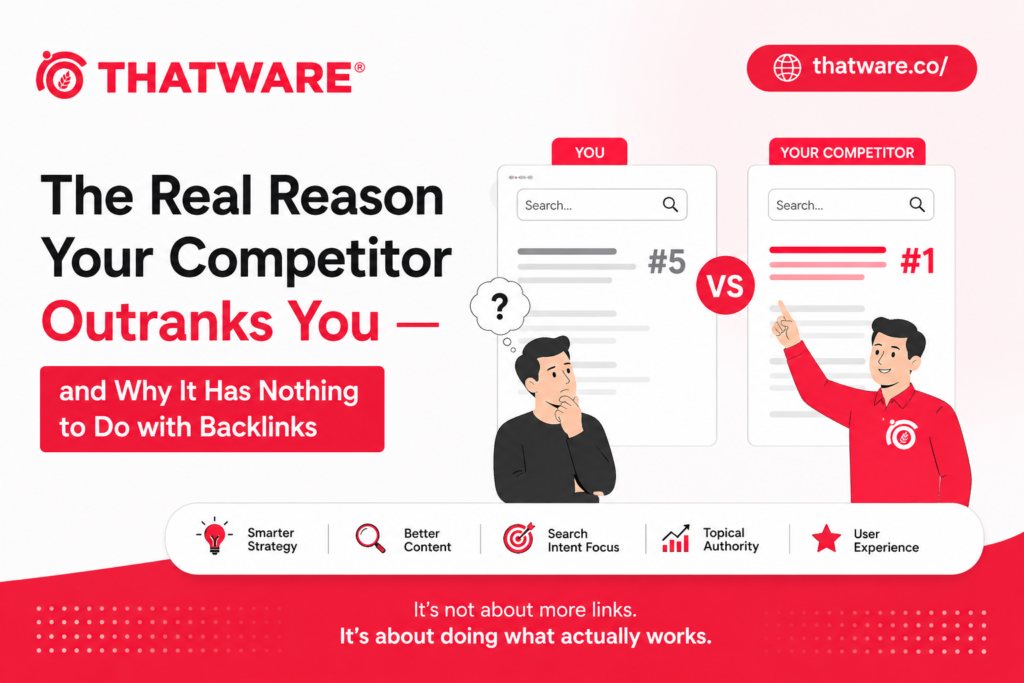
There’s a diagnostic conversation that happens a lot in SEO consultations. A client shows up frustrated. They’re doing everything right — technically clean site, regular content production, decent backlink profile, no obvious penalties. Their competitor is outranking them for the terms that matter most and has been for a year. The conventional audit finds nothing obviously wrong. The conventional answer is “you need more backlinks” or “you need more content.” Neither makes the problem fully go away.
The missing variable, more often than the industry acknowledges, is semantic authority. Specifically: Google’s understanding of your site as a coherent, authoritative entity in a specific topical domain versus your competitor’s standing on that same dimension. This is a different kind of signal from technical health or link count, and it explains ranking gaps that conventional audits consistently miss.
How Google Actually Evaluates Topical Authority
The keyword-centric model of search — optimize a page for a keyword, rank for that keyword — was always a simplification. It was a useful simplification for a while because search engines were themselves operating primarily on keyword matching. That’s not the environment we’re in anymore.
Google’s systems have built an increasingly sophisticated understanding of topics, entities, and their relationships. When evaluating whether your site should rank for a given query, Google isn’t just asking “does this page contain the right keywords?” It’s asking “is this site a genuinely authoritative source on this topic?” And that question is answered by looking at the breadth and depth of your topical coverage, the coherence of your content structure, the entity relationships your brand has established, and the consistency of your expertise signals across the web.
Your competitor that outranks you might have fewer backlinks and less technical polish. But if they’ve built coherent, comprehensive coverage of the topical domain you’re both competing in — and you haven’t — Google trusts their content more for queries in that domain. That trust is semantic authority, and it’s not captured by standard SEO metrics.
What Semantic SEO Is Actually Doing
Semantic seo services address this by working on the structural layer of how your content communicates topical authority to search systems.
Topic clustering is the most commonly discussed technique. Rather than publishing isolated pages optimized for individual keywords, semantic SEO builds content architectures where a central “pillar” page establishes authority on a broad topic, supported by a network of more specific cluster pages that cover subtopics in depth — all internally linked in ways that communicate the topical relationships clearly. This structure helps Google understand not just that you have content on a topic, but that you have comprehensive, organized authority.
Entity optimization goes deeper. It’s about ensuring that the entities in your content — your brand, your key products, your team’s expertise, your industry relationships — are defined, consistent, and connected to their wider semantic context. Schema markup, consistent entity naming across the site, clear “about” and author information, and off-site entity signals all contribute to how clearly Google can understand what your brand is and what it knows.
Semantic keyword research differs from traditional keyword research. Instead of identifying high-volume keywords and building content to target them, semantic research maps the conceptual territory of a topic — the full range of related questions, entities, attributes, and relationships — and ensures content covers that territory comprehensively. The goal is completeness of topical coverage, not optimization for a specific set of terms.
The Entity Graph and Why It Matters
One of the more important technical underpinnings of semantic SEO is the concept of the knowledge graph — Google’s internal representation of entities and their relationships. Your brand, if it has any meaningful web presence, exists as an entity in Google’s knowledge graph. The question is how complete and accurate that entity representation is.
A well-defined entity has: consistent naming and description across multiple sources, clear relationships to relevant categories, people, and concepts, verifiable factual attributes (location, founding date, products, areas of expertise), and authoritative references that confirm its existence and characteristics.
A poorly-defined entity — or a brand that Google’s systems haven’t clearly recognized as a distinct entity at all — is at a structural disadvantage in semantic search, because the systems evaluating topical authority can’t confidently associate your content with a trusted source.
Entity based seo services specifically work on improving how clearly your brand is defined in the knowledge graph — through structured data implementation, consistent entity signals across the web, Wikipedia and Wikidata presence where relevant, and systematic management of how your brand is described in external sources.
The Content Gap That Semantic Analysis Reveals
One of the most useful outputs of a semantic SEO analysis is what it reveals about your topical coverage gaps versus competitors who are outranking you. This is often more illuminating than a traditional keyword gap analysis.
Traditional keyword gap analysis shows you keywords your competitor ranks for that you don’t. Semantic gap analysis shows you the conceptual territories your competitor has covered that you haven’t — the subtopics, related questions, entity relationships, and semantic contexts that constitute genuine topical authority in your domain. These are often quite different findings, and the semantic gaps usually explain ranking differentials better than keyword gaps do.
For example, a competitor might outrank you for “enterprise data security” not because they’ve optimized a page for that specific keyword better than you have, but because they’ve built comprehensive coverage of the entire enterprise security domain — covering data security, network security, compliance, incident response, vendor security — in a way that your content library doesn’t match. Google trusts their data security content more because it exists within a comprehensive authoritative framework.
Fixing that requires building the framework, not just optimizing the individual page.
Why This Takes Time and Why That’s Actually Good News
Semantic authority builds slowly and compounds over time. A comprehensive content architecture and strong entity definition don’t produce immediate ranking improvements — they produce durable, structural ranking improvements that become increasingly hard for competitors to replicate as they develop.
This is actually good news for brands willing to invest in it, because it means the competitive moat it creates is deep. A competitor can copy your backlink strategy reasonably quickly. They can match your technical SEO relatively fast. They can’t easily replicate two years of systematic topical coverage building and entity development.
The brands with the most durable organic search positions — the ones that hold rankings through algorithm updates, resist competitive pressure, and consistently outperform their backlink profiles — almost universally have strong semantic authority. That’s not a coincidence. It’s the engine behind the results.